


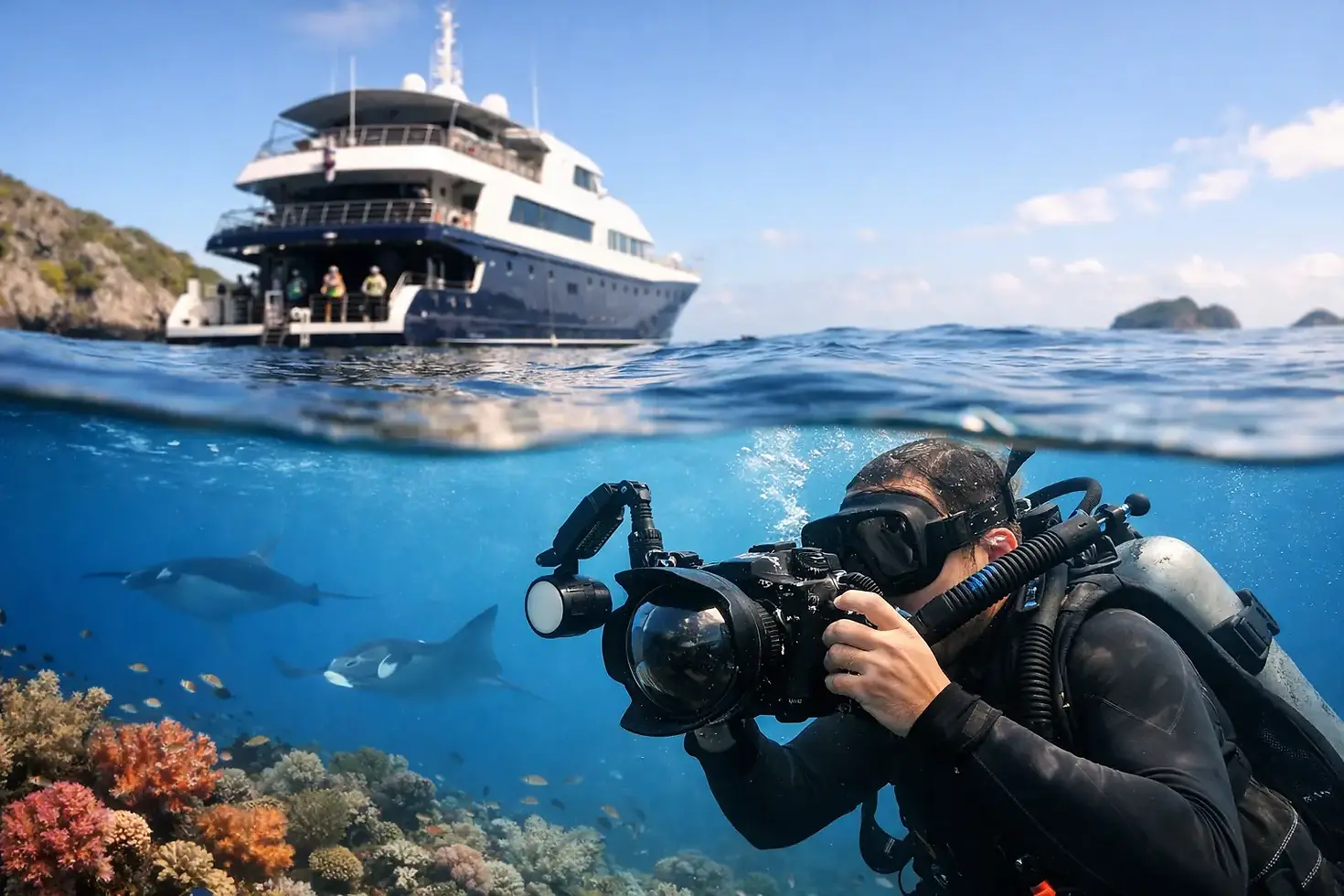
12 Best Liveaboards for Underwater Photography

You feel it on the first dive. The reef is loaded, the light is right, and then the current picks up, the skiff timing gets tight, or the camera table is too cramped for comfort. That is why the best liveaboards for underwater photography are not just about destination. They are about how well the whole trip supports the way photographers actually dive, shoot, rinse, charge, store, and repeat.
For photographers, a liveaboard can be the best trip format in diving. You get first access to prime sites, better timing for light and marine life behavior, and far less wasted transit time than a land-based itinerary. But not every boat that offers great diving is a great photography platform. Camera stations, charging setups, skiff procedures, dive deck flow, and even how the crew handles giant rigs all matter more than most brochures let on.
What makes the best liveaboards for underwater photography
A photo-friendly liveaboard usually gets the basics right before it promises anything fancy. You want a dedicated camera table with enough room to work, individual charging areas that do not turn into a mess of cords, freshwater rinse tanks clearly marked for cameras only, and crew who understand that a housing is not something to toss around with fins and weights.
Just as important is the diving itself. Photographers usually benefit from dive plans with enough flexibility to stay a little longer on a subject, current conditions that match the group’s skill level, and routes known for either strong macro or reliable wide-angle action. A boat can be luxurious, but if every dive is rushed and crowded, it is not a strong photography choice.
There is also a trade-off to keep in mind. The best wildlife destinations are not always the easiest photo trips. Some of the most spectacular pelagic itineraries involve strong current, negative entries, and quick ascents to tenders. That can be thrilling, but it is very different from a slower macro-focused trip where you can settle in and work a scene.
12 best liveaboards for underwater photography
Raja Ampat, Indonesia
If you want maximum variety in one trip, Raja Ampat is hard to beat. You can shoot soft corals, schooling fish, reefscapes, pygmy seahorses, wobbegongs, and manta rays without changing countries, much less oceans. It rewards both wide-angle and macro shooters, which makes it one of the easiest recommendations for mixed camera setups.
The catch is that boat quality and routing matter a lot here. Some itineraries focus more on iconic scenic reefs, while others lean into critter-heavy areas or seasonal manta encounters. For many photographers, Raja Ampat is the answer when they ask for the single best all-around liveaboard destination.
Komodo, Indonesia
Komodo is brilliant for drama. Think current-swept reefs, huge bait balls, mantas, and colorful hard and soft coral scenes that hold up beautifully in wide-angle. There is macro too, especially on the muck side of a broader route, but most photographers come here for big, energetic reef imagery.
This is not always a relaxed trip. Conditions can be demanding, and that affects who will enjoy it most. Experienced divers who are comfortable managing a camera in current usually love Komodo. Newer divers may still have a great trip, but only if the operator matches the route and conditions to their comfort level.
Anilao by liveaboard-style charter, Philippines
Strictly speaking, Anilao is better known as a resort destination, but private or small charter-style boat trips around the region can be outstanding for macro photographers. If your dream trip is nudibranchs, frogfish, shrimp, and bizarre little critters on black sand, this type of itinerary deserves attention.
This is a specialized pick, not a broad one. Wide-angle shooters may feel limited unless conditions line up for reef and schooling fish scenes. But for serious macro lovers, few places deliver so much subject density in such a compact area.
Tubbataha, Philippines
Tubbataha is one of the classic liveaboard-only destinations, and that exclusivity helps preserve the experience. The reefs are healthy, the walls are photogenic, and encounters with sharks, turtles, schooling jacks, and rays are common enough to keep wide-angle rigs busy all week.
It is seasonal and relatively short in operating window, so availability can be tight. It also tends to be more about big reef scenes than patient macro work. If your portfolio needs clear blue water and action, Tubbataha is a strong contender.
Lembeh plus North Sulawesi itineraries, Indonesia
Lembeh itself is the macro capital for a reason. Hairy frogfish, mimic octopus, flamboyant cuttlefish, blue-ringed octopus, and tiny oddballs that barely look real make this region a favorite for photographers who like to slow down and really work a subject.
On a broader North Sulawesi itinerary, you may be able to combine Lembeh-style muck with Bunaken walls and more classic reef scenes. That mix is attractive if one traveler wants macro and the other wants variety. Pure macro photographers, though, often prefer an itinerary that gives Lembeh the time it deserves.
Red Sea, Egypt
The Red Sea belongs on any serious list of the best liveaboards for underwater photography because it offers so much range. You can shoot wrecks, reefs, schooling barracuda, oceanic whitetips in season, dolphins, and colorful coral scenes with excellent visibility. It also tends to be one of the more accessible liveaboard regions in terms of price compared with some far-flung Indo-Pacific routes.
Different Red Sea itineraries create very different photo trips. Northern wreck routes are ideal for photographers who love structure, history, and ambient light work. Southern routes often lean more toward sharks and reef action. Choosing the right route matters as much as choosing the right boat.
Maldives
The Maldives can be magic for manta rays, whale sharks, and blue-water action. For photographers who want graceful big-animal encounters and cleaner backgrounds, it offers a very specific kind of reward. You are often shooting behavior and movement rather than intricate reef details.
That also means conditions can be less forgiving. Current is part of the deal, and some sites are better for watching the action unfold than for carefully composing a scene. If you are comfortable with that style of diving, the Maldives can produce unforgettable results.
Galapagos, Ecuador
Galapagos is a bucket-list trip for good reason. Hammerheads, marine iguanas, sea lions, schooling fish, penguins, and sheer biomass make it one of the most exciting wildlife photography destinations anywhere. When the action comes together, few places can touch it.
It is also not a casual photo vacation. Cold water, surge, current, fast-paced entries, and physically demanding diving all raise the bar. This is usually best for experienced divers who understand that spectacular wildlife does not always equal easy shooting.
Socorro, Mexico
If giant mantas are high on your wish list, Socorro should be near the top. The interactions can feel unusually close and prolonged, which gives photographers more room to compose instead of just react. Dolphins, sharks, and occasional whale encounters add to the appeal.
Socorro is less about reef variety and more about pelagic encounters. That makes it incredibly strong for some shooters and a bit one-note for others. If your goal is charismatic megafauna in blue water, that is not a weakness. It is exactly why you go.
Cocos Island, Costa Rica
Cocos is another advanced trip built around schooling sharks and big animal action. The energy underwater is the point. Photographers who want drama, scale, and open-ocean wildlife often come back with images that feel alive in a way calmer destinations rarely match.
Still, this is a narrow fit. It is expensive, remote, and demanding. If someone wants easy entries, long macro hunts, or a relaxed mixed-experience group trip, there are better options.
Palau
Palau gives photographers an unusually balanced menu - reefs, wrecks, sharks, jellyfish in season, caves, blue holes, and excellent visibility. It is one of the easier places to recommend for divers who want a little of everything without giving up image quality.
The best part is flexibility. A good itinerary can keep wide-angle shooters happy while still offering enough variety to avoid visual repetition. For many divers, Palau feels like a smart middle ground between extreme expedition diving and easier tropical reef trips.
French Polynesia
French Polynesia, especially the Tuamotus, is all about clear water, shark encounters, and elegant blue-water scenes. The visibility can be a dream for wide-angle work, and the animal life often delivers that clean, high-contrast look photographers love.
The trade-off is that current and drift conditions shape much of the experience. This is not usually a macro destination, and it is not the place to bring only one lens if that lens is for tiny critters. But for crisp pelagic imagery, it is outstanding.
How to choose the right boat, not just the right destination
The destination gets the attention, but the boat often decides whether the trip feels easy or frustrating. Ask how camera gear is stored during crossings, whether there are separate camera rinse tanks, how many photographers the boat typically carries, and whether charging is available at each station or only in shared areas.
It also helps to ask about the diving rhythm. Some photographers love four intense dives a day with quick turnarounds. Others would rather have fewer dives with more setup time and less pressure. Neither is wrong. The best fit depends on whether your priority is maximizing bottom time, fine-tuning images, or simply enjoying the trip without feeling rushed.
If you are traveling with a non-photographer or someone newer to diving, route choice becomes even more important. A world-class photo itinerary may still be the wrong vacation if one traveler is stressed the whole time. This is where good trip planning saves money and disappointment.
The best liveaboard depends on what you want to shoot
If you want macro, look hard at Lembeh-style trips, Anilao-style charters, and selected Indonesia itineraries that include muck diving. If your goal is wide-angle reefs and fish life, Raja Ampat, Komodo, Tubbataha, Palau, and the Red Sea are excellent places to start. If your dream images are all about giants and pelagics, Socorro, the Maldives, Galapagos, Cocos, and French Polynesia move to the front of the line.
That is usually the fastest way to narrow the field. Start with the images you want, then match the destination, season, and boat style to that goal. When that part is done well, everything else gets easier - and the trip feels like it was built around your diving, not the other way around.
The right liveaboard should make your camera feel like part of the trip, not extra baggage. Get that match right, and you spend less time managing gear and more time coming home with the shots you actually hoped for.


Comments