


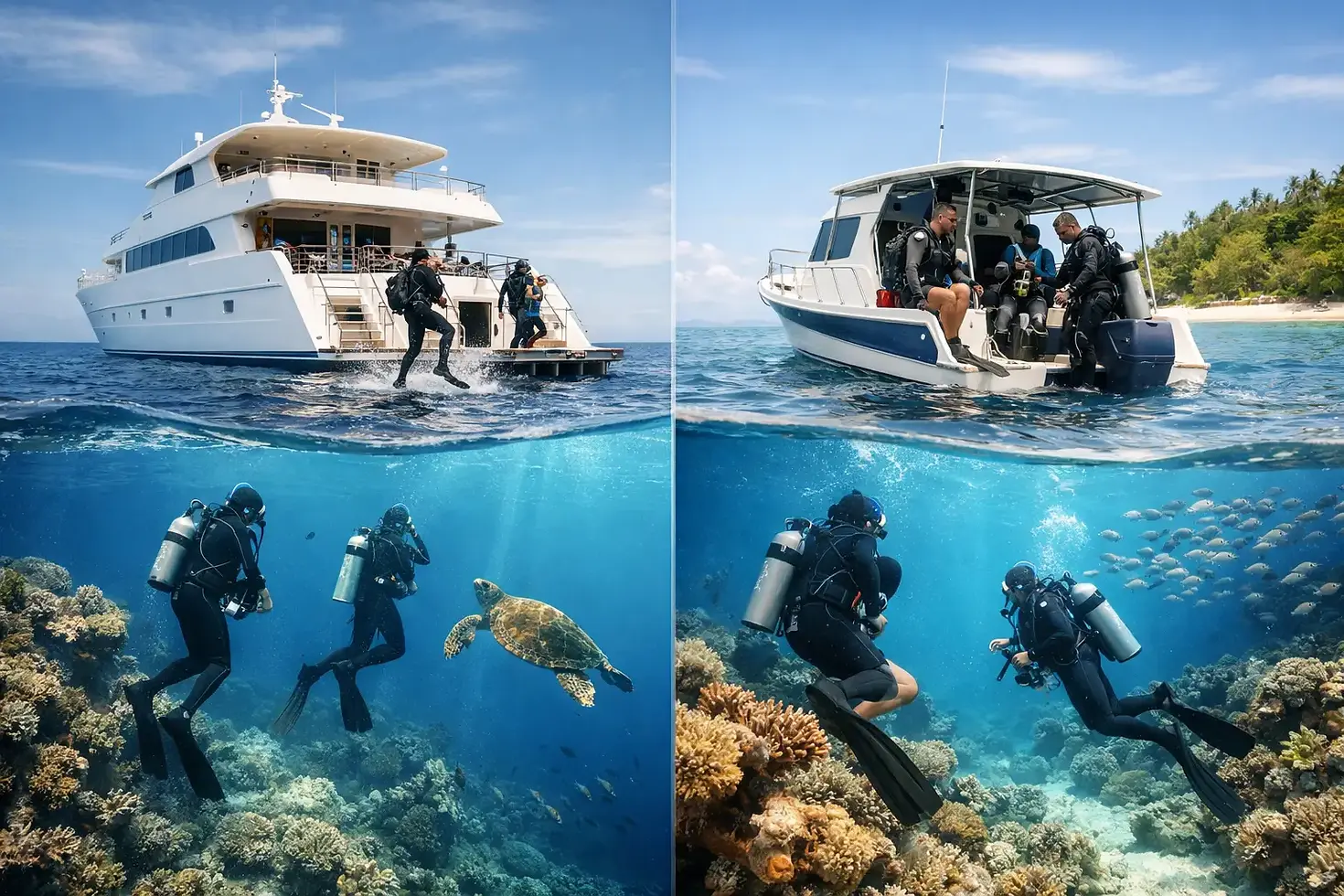
Liveaboard Diving vs Day Boat Diving
- Mandy Buttenshaw

- Apr 21
- 6 min read
You can tell a lot about a dive trip by what happens before the first giant stride. If you are boarding before sunrise with all your gear packed for a week at sea, that trip will feel very different from grabbing breakfast at a resort and heading to the marina for a single day on the water. When divers ask about liveaboard diving vs day boat diving, they are usually not just comparing boats. They are really asking which style will give them the best vacation, the best diving, and the fewest headaches.
Liveaboard diving vs day boat diving: the real difference
At the simplest level, a liveaboard is your floating hotel, dive platform, and daily schedule all in one. You sleep onboard, eat onboard, and move from site to site without returning to shore each night. A day boat trip is exactly what it sounds like - you stay on land and head out for one, two, or sometimes three dives before returning to your resort or hotel.
That basic difference shapes everything else. Your pace, how many dives you can log, what dive sites are realistic, how much privacy you have, how much downtime you get, and even what kind of non-diving experience fits into the trip all change depending on which format you choose.
Neither is automatically better. The right answer depends on how you like to travel, how much diving you want, who you are traveling with, and how much structure you enjoy.
Why many divers choose a liveaboard
If your main goal is maximum underwater time, liveaboards are hard to beat. You are already at the dive sites, so there is no daily transfer from a resort, no repeated loading and unloading of gear, and no losing prime morning conditions because of a long boat ride from shore. That efficiency usually translates into more dives across the trip.
Liveaboards also open access to dive areas that are simply too far for standard day trips. In some destinations, the difference is dramatic. The best reefs, pelagic action, or less crowded walls may be hours from land. Sleeping closer to the sites means you can reach places day boats either skip or visit less often.
There is also something special about the rhythm of a liveaboard. Wake up, coffee, briefing, dive, breakfast, relax, dive again, eat, nap, dive again. For divers who want to spend a week fully immersed in diving, it can feel like exactly what they hoped the trip would be.
That said, liveaboards are not the best fit for everyone. Cabins are compact. Schedules are fixed. You are sharing close quarters with the same group for several days. If you love total privacy, need lots of independent downtime, or know you get seasick easily, those trade-offs matter.
Liveaboards often make the most sense for experienced or dive-focused travelers
You do not need to be a technical diver or have hundreds of dives to enjoy a liveaboard, but the format usually appeals most to travelers who are comfortable with repetitive diving and a structured pace. Multiple dives a day for several days can be physically demanding, even when the diving itself is easy.
It also helps if you are confident with your gear and routine. Liveaboards tend to run efficiently, and that is a good thing, but it means the trip is less about easing into diving and more about getting after it.
Why day boat diving still wins for many vacations
Day boat diving is more flexible, and for a lot of travelers that matters more than squeezing in the maximum number of dives. You can dive in the morning, spend the afternoon by the pool, book a spa treatment, go sightseeing, or enjoy a nice dinner ashore. If your trip is part diving vacation and part broader getaway, staying on land usually gives you more options.
Day boats are also a strong choice for mixed-interest travel. Maybe one person in the couple dives and the other does not. Maybe you are traveling with friends who want a balance of diving and beach time. Maybe you want to include cultural touring before or after your dives. A resort-based itinerary makes that kind of planning much easier.
There is another practical advantage here: comfort and recovery. A good resort room is roomier than most liveaboard cabins. If you like quiet evenings, stable footing, and your own space after diving, day boat diving can feel more relaxed.
Day boats are often better for newer divers and vacation-first travelers
If you are recently certified, getting back into diving after a long break, or still figuring out what kind of diver you are, day boat trips can be a smart choice. You have more room to pace yourself. You are not committed to a nonstop dive schedule. And if conditions are tiring, you can skip a dive and still enjoy the trip.
For many people, that lower-pressure format leads to a better overall vacation. More diving is not always better if it leaves you exhausted by day three.
Cost is not as simple as it looks
A lot of divers assume day boats are always cheaper. Sometimes that is true. Sometimes it is not.
A liveaboard often looks expensive upfront because the package bundles lodging, meals, and diving into one rate. But if you compare that with a resort stay, daily dive packages, meals, transfers, and sometimes domestic flights to a more remote island, the gap can shrink quickly.
On the other hand, day boat diving gives you more control over your budget. You can choose your hotel level, dive fewer days, mix in shore diving, or build a shorter trip. That flexibility can make resort-based travel more affordable, especially for travelers who do not need to dive every day.
This is where destination matters a lot. In some places, the best value is clearly a liveaboard. In others, a resort and day boat combo gives you a better experience for the money.
The biggest trade-off: intensity vs flexibility
Most of this decision comes down to one core question. Do you want a dive trip built around diving, or do you want a vacation that includes diving?
A liveaboard is usually the first option. The trip has momentum. Meals, briefings, surface intervals, and overnight crossings all revolve around the dive plan. That can be fantastic if that is exactly what you want. It can also feel restrictive if, halfway through, you realize you wanted more time ashore.
A day boat itinerary is usually the second option. You get more freedom to shape the trip around your energy, your travel companions, and the destination beyond the reef. The trade-off is that you may do fewer dives, spend more time commuting, and miss some of the farthest sites.
How to choose between liveaboard diving vs day boat diving
Start with your trip goal, not the boat type. If this is a bucket-list dive vacation and your main priority is seeing as much underwater as possible, liveaboard diving may be the clear winner. If you are celebrating an anniversary, traveling with non-divers, or want a mix of diving and sightseeing, day boat diving may fit better.
Next, think honestly about your energy level. Four or five days of repeated dives can be amazing, but they are still a workout. If you know you prefer slower mornings, more personal space, or occasional non-dive days, that is useful information, not a sign that you are less serious about diving.
Then consider the destination itself. Some places are famous because the liveaboard routes are exceptional. Others shine as land-based vacations with great reefs, easy logistics, and plenty to do topside. The destination should shape the recommendation just as much as your budget or certification level.
Travel style matters too. Some divers love the social side of a liveaboard, where the whole group shares the same rhythm and every dinner turns into a reef recap. Others would rather have a quiet room on shore and the ability to step away after the boat returns. Neither is wrong.
When a combination trip is the best answer
Sometimes the best choice is not either-or. A split itinerary can work beautifully, especially for longer vacations. Start with a few resort nights to recover from travel, do easy check-out dives, and enjoy the destination. Then board a liveaboard for the more remote, dive-heavy portion. Or do it in reverse and finish with a few nights ashore to unwind before flying home.
This kind of trip works especially well for couples, small groups, and divers who want both intensity and comfort. It takes more coordination, but it can deliver the best of both formats without forcing you into one lane for the entire vacation.
That is often where expert trip planning really helps. Matching the right destination, boat style, resort, flight timing, and post-dive schedule is what turns a good idea into a smooth trip.
If you are stuck on liveaboard diving vs day boat diving, that is actually a good sign. It means you are asking the right question before booking the wrong format. The best dive vacation is not the one that sounds most adventurous on paper. It is the one that fits how you like to travel, how you like to dive, and what you want to remember when you get home. If you start there, the right trip usually becomes obvious pretty fast.


Comments